Date: 14-MARCH-2017 Last Updated: 15-SEPTEMBER-2026
Why You May See a Saw‑Tooth Pattern in Your UV Baseline
A saw‑tooth or jagged repeating pattern in an HPLC UV baseline usually indicates the presence of residual immiscible solvents inside the column. Even trace amounts can disrupt flow uniformity and refractive index balance, causing the baseline to oscillate or “saw‑tooth” as the mobile phase passes through. This phenomenon can occur on any column, including Cogent TYPE‑C™ columns, when incompatible or non‑miscible solvents have been introduced at some point in the workflow.
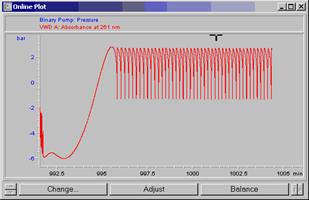
How Immiscible Solvents Create the Problem
When a solvent that does not fully mix with the mobile phase becomes trapped within the column:
- Small pockets of the immiscible fluid remain in the packing bed.
- These pockets intermittently disrupt the flow path.
- Localized disturbance causes fluctuating absorbance, resulting in the characteristic saw‑tooth pattern.
Because TYPE‑C columns have high surface area and hydride‑modified silica, residual non‑polar solvents can linger if not fully flushed. This especially occurs if the column was previously exposed to hexane or other non‑aqueous, non‑miscible solvents.
In some cases, new columns may also contain small amounts of packing solvents that can cause similar effects until fully conditioned.
The Fix: Flush with a Mutually Miscible Solvent
We recommend a simple and effective solution: Flush the column overnight with a solvent that is mutually miscible with both the mobile phase and any residual trapped solvent.
The most recommended solvent is: ✔ Isopropanol (IPA) IPA’s intermediate polarity allows it to dissolve or displace both aqueous and organic residues inside the pore structure.
Step‑By‑Step Recommended Procedure
- Stop the run and disconnect the column from the detector if needed.
- Set the pump to run 100% isopropanol (IPA) or another suitable miscible solvent.
- Begin at a low flow rate to avoid pressure shock.
- Increase the flow gradually to the normal operating rate.
- Flush overnight to ensure complete removal of trapped immiscible solvents.
- After flushing, transition slowly back to your normal mobile phase.
Once complete, the baseline should return to stable, drift‑free performance.
Why This Works
Flushing overnight with IPA:
- Breaks up and dissolves immiscible solvent pockets
- Uniformly reconditions the stationary phase
- Restores stable refractive index and absorbance conditions
- Eliminates oscillation caused by intermittent flow disruptions
After treatment, the column behaves exactly as intended with no long‑term effects on performance.
Conclusion
A saw‑tooth UV baseline pattern is almost always the result of residual immiscible solvents trapped inside the column.
Fortunately, the fix is both simple and highly effective: flush the column overnight with isopropanol or another mutually miscible solvent. This restores smooth baseline behavior and full chromatographic performance.